analytics

Showing posts with label administrator. Show all posts

Monday, May 7, 2012

Automatic renew of credentials in IBM Cognos 10

If you remember in Cognos 8, you had to update credentials everytime in schedules after changing your login password otherwise schedules would fail. If not, here is the link to refresh your memory (if you are still on Cognos 8)
http://publib.boulder.ibm.com/infocenter/caapps/v8r4m0/index.jsp?topic=/com.ibm.swg.im.cognos.ug_cc.8.4.1.doc/ug_cc_i_ScheduledReportsFail.html

However, since this was kind of tedious job if you had large number of schedules defined. In Cognos 10, this wasn't required as it was designed to automatically renew credentials. However, there have been cases, where this was misunderstood. We came across one such occasion and had to publish a technote clarifying the concept of automatic renew of credentials in IBM Cognos 10.

You can read the technote here.
http://www-01.ibm.com/support/docview.wss?uid=swg21591076

Funny thing, you could turn this good feature off too ;)

Wednesday, March 14, 2012

What is CMCAPACITY table?

Recently, I was approached for clarification on CMCAPACITY table and what does it do. Well here's the simple answer

The CMCAPACITY  table keeps track of the registered dispatchers.  Just do a test on your machine, when you start CM, you'll see your dispatcher with usage = 4 and when you shutdown, it should be blank.
 
If CM has a row = 4  and CM is not running, it could have been improperly shutdown or something of that nature. If there is a usage of 4, it can prevent CM from locking the content store DB on start-up of IBM Cognos.

Well, if you love complex answers, there an developer works article and utilities about understanding your Cognos Content Store database using Content Manager Size and Browser Tools

Tuesday, January 10, 2012

What's inside Cognos Audit DB tables?

I was (like some of you), curious about what kind of structure does audit database has. I was always interested to find out what's actually getting stored in various tables that I talked about earlier. Well, I've found one link on ibm's website which gives pretty much every information about the tables and the columns it stores in audit database.

It's really helpful if you want to trace the stats and error conditions or maybe to start a deep investigation about your IBM Cognos environment.

The audit table definitions can be read here. Click on individual table to get its column details.

http://publib.boulder.ibm.com/infocenter/cbi/v10r1m0/index.jsp?topic=%2Fcom.ibm.swg.im.cognos.ug_cra.10.1.0.doc%2Fug_cra_id56716asg_table_definitions.html

There's a lot to explore here. I'll be doing that in free time and posting about those. Till then, you could go ahead and browse table's structure and define your own ways to use audit database information to get more insight into IBM Cognos's behaviour.

Sunday, December 11, 2011

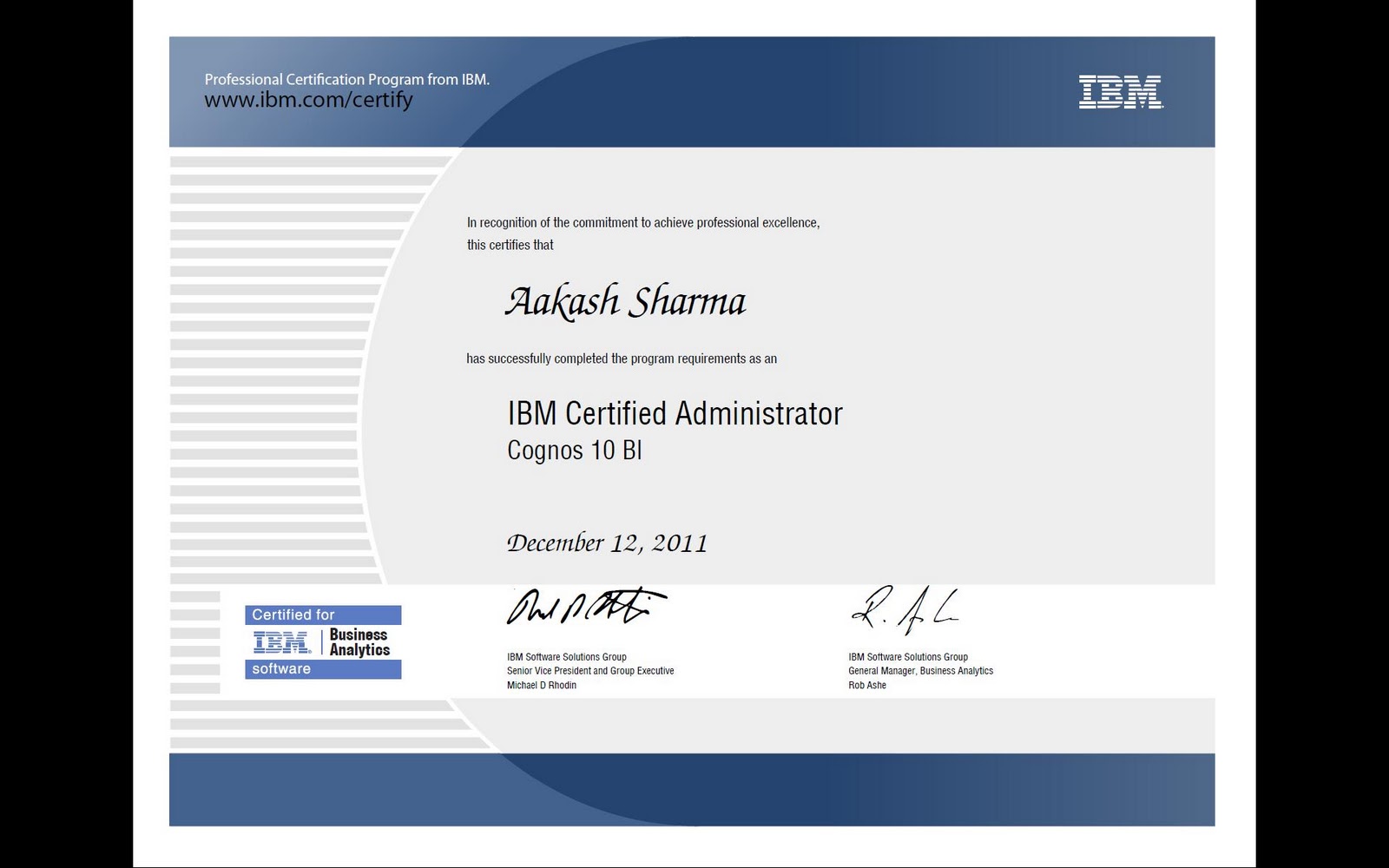
IBM Cognos 10 BI Administrator Certification

This morning, I gave a test which is technically known as COG-622 but better known as IBM Cognos 10 Administrator Certification. Well, I passed and there was a lot of learning that I gained from preparing for it.

My biggest mistake was the order in which I started preparing for it. Well, if someone is trying to prepare for it, you don't need any thing other than IBM books.

Preparation Material:

1. IBM Cognos Business Intelligence Installation and Configuration Guide 10.1.0

Yep, that's enough for you to score in exam. I studied books in order 2, 1, 3 which I think is kind of stupid. I should have done it like 1, 3, 2. Well, that's upto individual but if you don't have much time (like I had), that's the best way to score.

I believe 1 week (smooth learning) or 3 days (stressed learning) is enough for this exam. Still, if anyone has doubt or need help preparing for it, just comment here.

p.s. It's a 47 question MCQ exam of duration 1 hour. You could easily finish in 30 minutes ;)

update: here's what the certificate looks like, just to get you excited ;)